
Cleaning
Cleanliness is quality.
Why cleaning is important
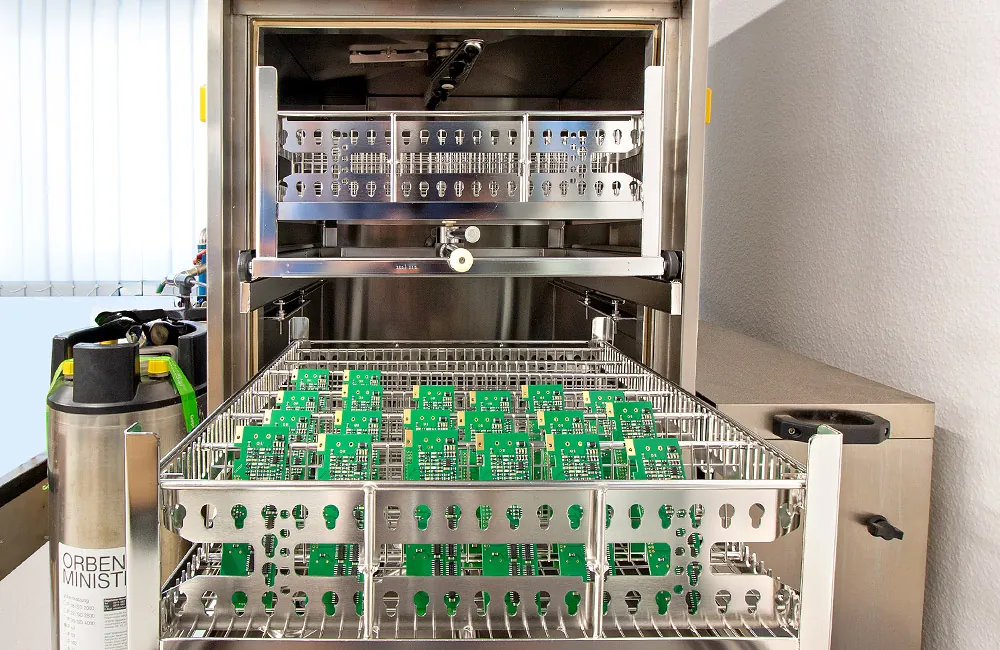
PCB cleaning is the basis for a durable protective coating. Residues such as flux, dust, oil, or oxides prevent the even adhesion of the coating and lead to delamination, increased leakage current, or electrical faults. For industrial precision cleaning, we use a machine from Riebsam’s 22 series, which delivers reproducible cleanliness values and short cycle times.
Selective coating processes only achieve their full precision on clean surfaces. Cleaning is not a cost factor but a gain in quality and reliability.
Risks associated with inadequate cleaning
- Coating adhesion problems; delamination and rework
- Increased leakage current due to ionic residues; reduced reliability
- Corrosion at solder joints and conductor tracks; shortened service life
- Short circuits due to conductive contaminants; risk of failure in field applications
Frequently Asked Questions (FAQ) About Cleaning
Why can cleaning electronic assemblies be important?
Cleaning electronic assemblies can be an important process step when specific product requirements apply. It serves to specifically remove residues such as flux, dust, oil, particles, or other contaminants.
Whether an assembly should be cleaned depends on the application, the materials used, the required reliability, and the subsequent process steps. SE-TEC therefore approaches assembly cleaning on a project-by-project basis and coordinates it with the client.
When should printed circuit boards or electronic assemblies be cleaned?
Cleaning is particularly advisable when there are heightened requirements for reliability, insulation, long-term stability, or protective coatings. A defined cleaning process may also be necessary for assemblies intended for demanding environments.
Before cleaning, the assembly’s compatibility with the cleaning process must be verified. This involves assessing whether the printed circuit board, components, markings, connectors, switches, sensors, or other parts are suitable for the cleaning process. This coordination takes place between SE-TEC, as the EMS service provider, and the product managers on the customer’s side.
How does SE-TEC clean electronic assemblies?
At SE-TEC, cleaning is performed under controlled conditions as part of an automated process. Special cleaning agents tailored to electronic assemblies and their specific requirements are used in this process.
Conductivity measurement is one of the methods used for process control and quality assurance. It supports the monitoring of the cleaning process and helps ensure reproducible cleaning quality.
What risks arise from improper or inadequate cleaning?
Inappropriate or inadequate cleaning can compromise the quality and reliability of electronic assemblies. Potential risks include residues on the assembly, adhesion problems with protective coatings, increased leakage currents, corrosion, short circuits, or other electrical faults.
At the same time, not every assembly is automatically suitable for cleaning. Therefore, a prior assessment of cleaning compatibility is crucial to avoid compromising components, materials, and functions.
Is cleaning necessary before applying a protective coating?
Cleaning may be advisable or necessary prior to applying a protective coating, as paints, nano-coatings, or other protective systems can only adhere reliably to suitable and clean surfaces.
Whether cleaning is necessary depends on the assembly, the residues present, the coating system, and the requirements of the end product. SE-TEC evaluates this step on a project-by-project basis and coordinates the appropriate procedure with the client.