
Coating
Precise coating
Precise PCB coating with MYC50
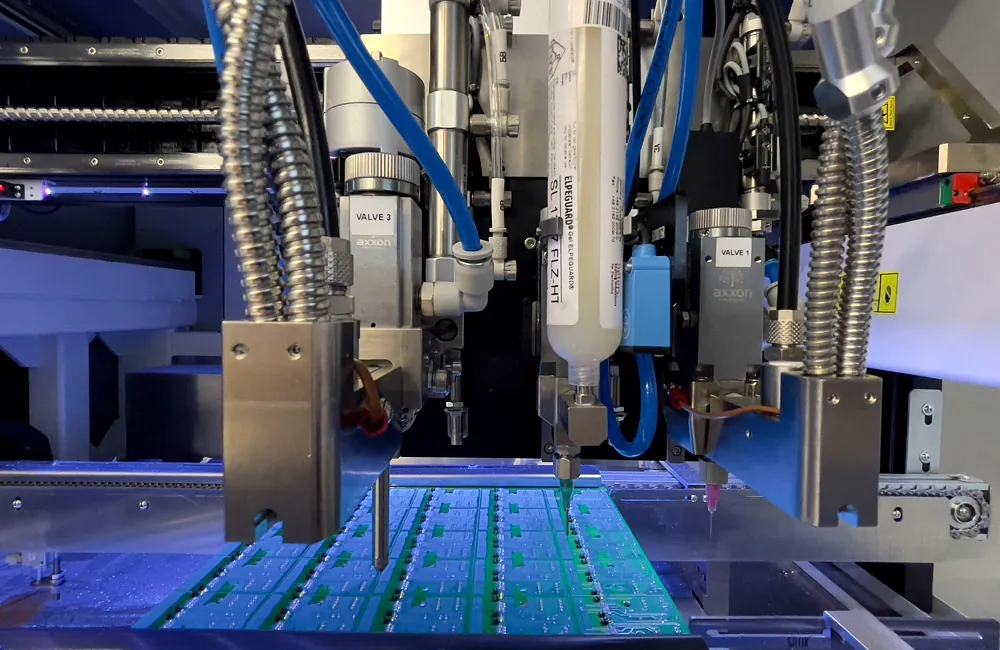
We have expanded our range of services to include a modern MYC50 (Mycronic) coating system, enabling us to offer reliable, reproducible coatings for PCBs and modules. The system uses laser height measurement, heating modules, and closed-loop control to ensure precise dosing and even distribution of the coating material.
Performance characteristics
- Versatile valve technology: Three valve types cover different requirements; spray valve for large-area coatings; needle valve for hard-to-reach areas; dispenser for precise application of dam material
- High process stability: Automated control loops ensure consistent layer thicknesses and precise contours
- Gentle treatment of sensitive components: Connectors and sensitive components remain free of paint thanks to dam technology
Protective coating and operating values
SL1307FLZ/2 (Lackwerke Peters) significantly increases the reliability and service life of the assemblies. The temperature resistance from -65 to +125 °C ensures operability even in demanding environments.
Frequently Asked Questions (FAQ) About Conformal Coating
What is conformal coating for electronic assemblies?
Protective coating, often referred to as “conformal coating” in international technical circles, is a process in which electronic assemblies are applied with a thin, protective layer. This protective layer conforms to the contours of the printed circuit board and the components, protecting the electronics from moisture, dirt, corrosion, and other environmental influences.
SE-TEC offers precision PCB coating, or conformal coating, for assemblies with heightened requirements for reliability and service life.
When is it advisable to apply a coating to a printed circuit board?
Applying a conformal coating to a printed circuit board is recommended when electronic assemblies are used in demanding environments. These include applications involving moisture, temperature fluctuations, dust, chemical exposure, or an increased risk of corrosion.
The protective coating helps reduce electrical failures and extend the service life of the assembly.
Can certain areas of an assembly remain free of coating?
Yes. With selective coating, specific areas such as connectors, contacts, test points, or sensitive components can be deliberately excluded. This ensures that necessary electrical or mechanical functions are preserved.
SE-TEC uses precise automated coating systems tailored to the requirements of each assembly. This allows the conformal coating to be applied where it is needed, while defined exclusion zones remain reliably free of coating.
How is it determined whether the coating was done correctly?
A UV tracer is incorporated into the protective coating to monitor it. After the coating process, UV light can be used to verify whether the coating is present where it is required and whether areas where no coating was applied have remained reliably free of it.
This is particularly important for connectors, contact surfaces, test points, or other areas that must not be coated. UV inspection supports reproducible process control and contributes to the quality assurance of coated assemblies.
How does SE-TEC prevent protective coating from seeping into sensitive areas?
If necessary, SE-TEC can also use a special, highly thixotropic barrier material. This material forms a defined barrier and prevents protective coating from reaching sensitive areas due to creep or capillary effects.
This is relevant, for example, when coating could migrate from soldered pins toward the contact surfaces of connectors. Through the targeted use of the barrier material, functional contact areas remain securely protected and free of coating.
Why is an even coating important?
An even coating ensures consistent protection and reliable quality. Too little coating can result in gaps in protection, while too much coating can impair components, contacts, or mechanical functions.
Therefore, precise dispensing, defined contours, controlled processes, and a subsequent inspection are essential for a reliable protective coating or high-quality conformal coating.